

What was Nelson Rockefeller's net worth?
Nelson Rockefeller was an American businessman and politician who had a net worth $218 million. That's the same as around $1 billion today after adjusting for inflation. In a financial disclosure, he revealed that over his lifetime, he had paid $69 million in taxes, roughly $350 million in today's dollars.
A member of the prominent Rockefeller family, Nelson Rockefeller served as the governor of New York from 1959 to 1973 and as the vice president of the United States under Gerald Ford from 1974 to 1977. Beyond government, he was the president of Rockefeller Center, co-founder of the Rockefeller Brothers Fund, and trustee, treasurer, and president of the Museum of Modern Art.
Early Life and Education
Nelson Rockefeller was born on July 8, 1908, in Bar Harbor, Maine, into the prominent Rockefeller family. His father, John D. Rockefeller Jr., was a financier and philanthropist and the only son of John D. Rockefeller, the founder of Standard Oil, while his mother, Abigail Aldrich Rockefeller, was a noted socialite, art patron, and philanthropist. Rockefeller had two older siblings, Abigail and John D. Rockefeller III, and three younger brothers, Laurance, Winthrop, and David Rockefeller. Jay Rockefeller is his first cousin.
He was raised in his family's various homes in New York City, and also in a country home in Pocantico Hills, New York and a summer home in Seal Harbor, Maine. Rockefeller was educated at the Lincoln School in Manhattan, which was funded by his family. He went on to attend Dartmouth College, from which he graduated with a degree in economics in 1930.
Career Beginnings in Business
Rockefeller joined the family business after he graduated from Dartmouth. He joined the board of directors of Rockefeller Center in 1931 and later served as its president from 1938 to 1945. Rockefeller also had a few terms as chairman. Elsewhere, he worked at the Creole Petroleum Corporation and served on the board of health for Westchester County.
Political Career, 1940-1958
Rockefeller joined the government in 1940 when President Franklin D. Roosevelt named him to the new position of coordinator of Inter-American Affairs. In this role, he oversaw the United States' cooperation with Latin American countries to improve life there and resist Nazi influence. Rockefeller was subsequently appointed by Roosevelt as assistant secretary of state for American Republic Affairs in 1944. The following year, he was a member of the US delegation at the United Nations Conference on International Organization. Rockefeller was a key influence in persuading the UN to establish its headquarters in New York City. After President Truman took office, Rockefeller was fired and the Office of the Coordinator of Inter-American Affairs was shut down. Rockefeller continued his work by forming the International Basic Economy Corporation in 1947, where he served as president on-and-off through 1958.
In 1950, Rockefeller returned to government when Truman named him chairman of the International Development Advisory Board. A couple of years later, when President Eisenhower took office, Rockefeller was named chairman of the Advisory Committee on Government Organization. In that position, he recommended several reorganization plans for the federal government, leading to the creation of the Department of Health, Education and Welfare. Rockefeller became under-secretary of this department in 1953, serving in that role until 1954 when he was appointed special assistant to the president of foreign affairs. In 1956, he created the Special Studies Project to identify core problems facing the United States and delineate national objectives.
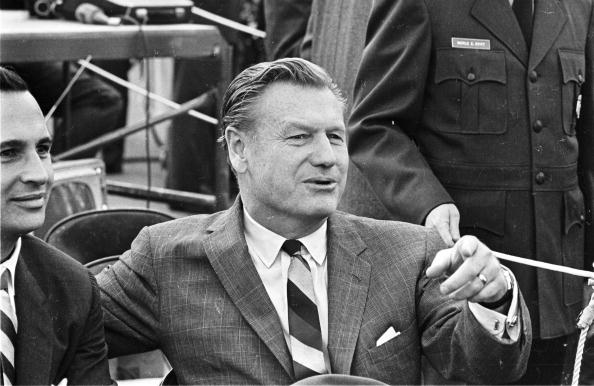
Getty
Governor of New York
In 1956, Rockefeller left the federal government and began political work in New York State. After chairing the Temporary State Commission on the Constitutional Convention and the Special Legislative Committee on the Revision and Simplification of the Constitution, Rockefeller was elected governor of New York. He would go on to win reelection in 1962, 1966, and 1970. As governor, Rockefeller led efforts to protect the environment, increase healthcare resources, prohibit housing and job discrimination, and stem drug use. He also expanded the State University of New York system, the state police force, and mass transpiration, and helped to create the New York State Council on the Arts and construct the Empire State Plaza. Rockefeller was considered moderate-to-liberal as a Republican governor. Just ahead of the 1960 Republican National Convention, he reached an agreement with Richard Nixon, called the Treaty of Fifth Avenue, to make changes to the Republican Party platform.
Vice President of the United States
Following three unsuccessful bids for the Republican presidential nomination in 1960, 1964, and 1968, Rockefeller became vice president of the United States under Gerald Ford in 1974. During his time as vice president, which lasted until 1977, Rockefeller was notorious for his staunch support of the Vietnam War and his close connections to the military-industrial complex. He chose not to seek a full vice-presidential term in Ford's 1976 election campaign, and he retired from politics after leaving office.
Philanthropy and Arts Patronage
In 1940, Rockefeller and his four brothers founded the Rockefeller Brothers Fund to foster positive social change. He served as a trustee of the organization for many years and was president in 1956. Meanwhile, Rockefeller created the American International Association for Economic and Social Development in 1946. Elsewhere, he was majorly involved with the Museum of Modern Art, serving as a trustee from 1932 to 1979 and as president from 1939 to 1941 and again from 1946 to 1953. Rockefeller amassed a large art collection and was a strong proponent of public access to the arts. In 1954, he founded the Museum of Primitive Art, and in 1977 he founded the Nelson Rockefeller Collection to produce and sell licensed reproductions of some of the works in his collection.
Personal Life and Death
In 1930, Rockefeller married Mary Clark. They had five children together: Rodman, Ann, Steven, and twins Mary and Michael. After the couple divorced in 1962, Rockefeller married Margaretta Fitler in 1963. Together, they had two sons named Nelson Jr. and Mark. During both of his marriages, Rockefeller had multiple affairs with other women, including one allegedly with his much younger aide Megan Marshack.
On January 26, 1979, Rockefeller died from a heart attack. His remains were cremated and buried in the private Rockefeller cemetery in Sleepy Hollow, New York.
Read more: Nelson Rockefeller Net Worth




0 Comments