

Daniel Lubetzky could have named his snack company anything. He chose "KIND."
That word was not a marketing accident. Lubetzky, the billionaire founder of KIND Snacks, was raised by a father who survived the Holocaust and taught his children that kindness was not weakness. It was survival. It was strength. It was a choice people make when circumstances give them every reason to choose something darker.
Decades later, Lubetzky carried that lesson into one of the most competitive places in American retail: the snack aisle. He did not invent the nutrition bar. He did not invent almonds, dried fruit, transparent packaging, or grab-and-go snacking. What he did was combine all of those things with a name and mission that made people feel like they were buying something honest.
That deceptively simple idea became KIND Snacks, a company that Mars eventually acquired in a deal widely reported to value the brand at around $5 billion. It also made Daniel Lubetzky a billionaire with a net worth of $2.3 billion.
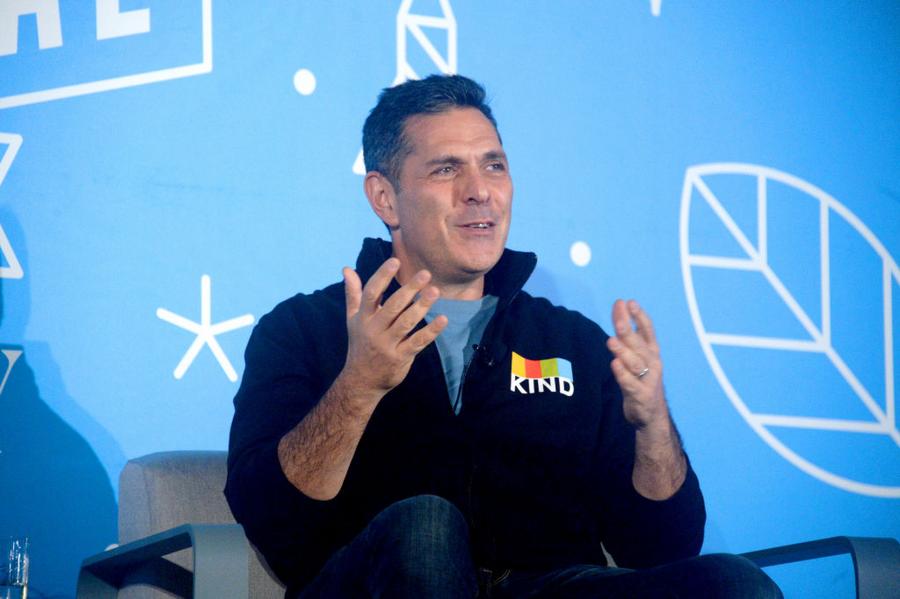
Brad Barket/Getty Images
The Son Of A Survivor
Lubetzky was born in Mexico City in 1968. His father, Roman Lubetzky, had survived Dachau as a child after the Nazis invaded Poland and his family was sent first to a ghetto and later to the concentration camp. Roman eventually immigrated to Mexico with Daniel's grandfather, arriving with almost nothing.
For Daniel, that family history became more than biography. It became the emotional foundation of his career. He grew up hearing stories about cruelty, dignity, resilience, and the small acts of decency that could mean the difference between life and death. His father's lessons did not lead him toward bitterness. They pushed him toward bridge-building.
That is the thread running through Lubetzky's entire career: business could be profitable, but it also had to be human.
The First Experiment: Food As A Bridge
Before KIND, Lubetzky founded PeaceWorks, a food company built around cooperation in the Middle East. The idea was bold and idealistic: use commerce to create shared interests among people divided by conflict. PeaceWorks sold products such as sun-dried tomato spreads and other Mediterranean foods made through cross-border partnerships involving Israelis, Palestinians, Arabs, and others in the region.
PeaceWorks did not become a multibillion-dollar giant, but it revealed Lubetzky's operating system. He was not interested in business as a purely transactional game. He wanted companies that could create economic value while also nudging people toward empathy.
That phrase, "not-only-for-profit," became central to how he thought. A company could make money and do good. A founder could pursue growth and values. A brand could sell products and stand for something.
The Snack Aisle Problem
By the early 2000s, the snack-bar aisle was crowded but uninspiring. Many bars looked like candy bars pretending to be health food. Others were wrapped in diet language, packed with ingredients customers could not pronounce, or covered in coatings that made them feel more like processed desserts than simple snacks.
Lubetzky saw an opening. What if a bar showed you exactly what was inside? What if the ingredients were visible through the wrapper? What if nuts, fruit, grains, and honey could be presented without making the product feel clinical or joyless?
KIND launched in 2004 with that premise. The packaging was transparent. The ingredients were recognizable. The name was warm, memorable, and flexible. "Kind to your body" suggested nutrition. "Kind to your taste buds" promised flavor. "Kind to the world" gave the company a broader purpose.
It sounds obvious now. At the time, it was a genuine retail insight.
The Grind Behind The Breakthrough
KIND did not explode overnight. Lubetzky built the company the hard way: sampling, pitching retailers, fighting for shelf space, refining products, and trying to make a small brand stand out in stores dominated by giants.
The company's growth depended on trust. Customers could see the almonds. They could see the fruit. They could understand the product in a second. That mattered in a category filled with claims, buzzwords, and diet trends.
Lubetzky also understood that the brand had to feel consistent. KIND could not preach empathy externally while operating like a ruthless machine internally. He pushed a culture that rewarded transparency, stock ownership, and shared purpose. The name on the wrapper had to mean something inside the company, too.
That combination of simple ingredients, strong branding, and moral clarity turned KIND from a startup into a national food brand.
The FDA Fight That Made KIND Look Smarter
One of KIND's most important moments came from an unexpected opponent: the FDA.
In 2015, the agency challenged KIND's use of the word "healthy" on certain products because some bars exceeded the regulatory limit for fat. The problem was that the fat came largely from nuts, including almonds. Under the old rules, a food could be penalized for containing the very ingredients many nutrition experts considered healthy.
KIND pushed back. The company removed certain language where required, but it also argued that nutrition science had moved beyond a simplistic view of fat. Nuts were not junk food. Almonds were not the enemy. A food made with nutrient-dense ingredients should not be treated the same way as an empty-calorie snack merely because of an outdated fat threshold.
The FDA later allowed KIND to use "healthy" again in connection with its corporate philosophy. More importantly, the episode made KIND look principled rather than cornered. The fight reinforced the company's core message: customers deserved food rules that made common sense.
The $5 Billion Payoff
Mars, the privately held food giant behind brands such as M&M's and Snickers, first invested in KIND in 2017. In 2020, Mars agreed to acquire KIND North America. The terms were not publicly disclosed, but the transaction was widely reported to value KIND at around $5 billion.
For Lubetzky, the sale was proof that purpose and profit were not enemies. He had built a giant business around a word that many executives might have dismissed as soft. KIND was not soft. It was disciplined, distinctive, scalable, and beloved by consumers.
The deal made Lubetzky a billionaire and turned KIND into one of the great consumer-brand success stories of the 21st century.
From Founder To Shark
After KIND, Lubetzky became a more visible investor, eventually joining "Shark Tank" as a full-time Shark beginning with season 16. His style on the show reflects the same philosophy that built his company. He looks for founders with grit, self-awareness, and a sense of purpose beyond the next purchase order.
He is not the loudest Shark. He does not need to be. His credibility comes from having taken a product from idea to grocery-store staple to multibillion-dollar exit.
Lubetzky has also continued building civic and philanthropic ventures, including the Kind Foundation, Feed the Truth, Starts With Us, Builders, and other efforts aimed at reducing polarization, improving food policy, and encouraging people to work across divides.
The Billion-Dollar Lesson
The inspiring part of Daniel Lubetzky's story is not simply that he became rich. Plenty of founders get rich. What makes his story resonate is that he built the fortune without abandoning the lesson that started it all.
His father survived one of history's darkest chapters and taught his son that kindness could be a form of courage. Lubetzky then took that belief into business, first through PeaceWorks and then through KIND Snacks. He built a company around transparent ingredients, transparent values, and a name that asked customers to believe in something better.
A snack bar did not change the world. But it changed Lubetzky's life, made him a billionaire, and proved a rare point in modern business: a company can lead with decency and still win big.
KIND began as a product you could see through the wrapper. Its real power came from something less visible: a founder who believed kindness was not just a slogan, but a strategy.
Read more: Daniel Lubetzky Turned His Father's Holocaust Survival Lessons Into A $5 Billion Snack Empire


0 Comments