

What is Alan Moore's net worth?
Alan Moore is an English writer who has a net worth of $3 million. Considering the success and impact of his creations, you might have assumed Alan Moore's net worth was much higher. Skip down to the next section to understand the surprising explanation for his relatively "small" current fortune.
Alan Moore is an English writer widely regarded as one of the most influential and innovative figures in the history of comic books and graphic novels. Over the course of his career, Moore helped elevate the medium from niche entertainment into a respected literary form, blending complex narratives, philosophical themes, and experimental storytelling techniques. He is best known for groundbreaking works such as "Watchmen," "V for Vendetta," "The Killing Joke," "From Hell," and "The League of Extraordinary Gentlemen," all of which pushed the boundaries of what comics could achieve both artistically and intellectually. Moore's writing often explores power, morality, politics, and the nature of reality, frequently incorporating dense symbolism and nonlinear structures. Despite his immense success and the enormous corporate value generated by the intellectual property he helped create, Moore has maintained a famously contentious relationship with major publishers and Hollywood studios. In later years, he distanced himself from the mainstream comics industry, focusing on novels and independent projects, while becoming equally well known for the millions of dollars he has deliberately refused on principle.
Why Alan Moore's Net Worth Is Surprisingly Low
Based purely on the cultural footprint and corporate value of the intellectual property he helped create, you might assume Alan Moore was worth between $50 million and $100 million. His stories have generated billions of dollars across publishing, film, and licensing. Yet his actual net worth is widely estimated to be in the low single-digit millions.
This gap is not the result of poor financial decisions. It is the result of deliberate, long-standing choices.
When Hollywood began adapting his works into major films such as "Watchmen," "V for Vendetta," and "Constantine," Moore took an unprecedented stance. He demanded his name be removed from the credits and refused to accept any share of the film royalties. For years, he directed studios to give his share of backend profits to his co-creators, including artists like Dave Gibbons and David Lloyd.
More recently, Moore has taken this principle even further. In 2023, he instructed DC Comics to donate any future film and television royalties owed to him directly to the Black Lives Matter movement. By rejecting screenwriting credit, backend participation, and licensing payouts, Moore has voluntarily walked away from tens of millions of dollars.
Instead, his income comes primarily from traditional sources: royalties from the print sales of books like "Watchmen," which continues to sell millions of copies; revenue from creator-owned works such as "From Hell" and "Lost Girls"; and advances from his later prose publishing deals.
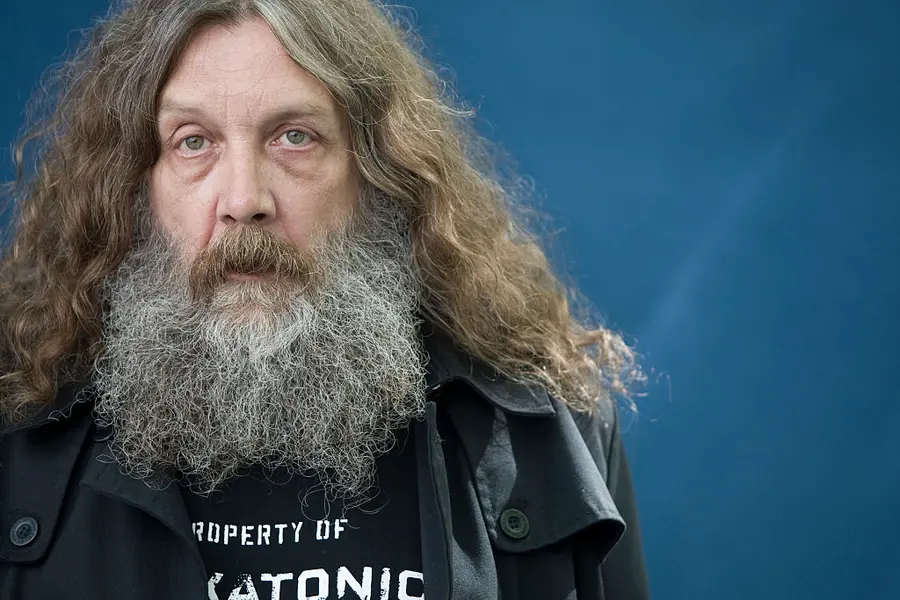
(Photo by Colin McPherson/Corbis via Getty Images)
Early Life
Alan Moore was born on November 18, 1953, in Northampton, England, a working-class town that would later serve as the backdrop for many of his stories. Raised in a modest household, Moore developed an early love for reading, devouring everything from pulp fiction and science fiction magazines to classic literature. He attended Northampton Grammar School, where his intelligence was evident, but his rebellious nature led to trouble. At age 17, he was expelled for selling LSD, effectively ending his formal education.
Following his expulsion, Moore took on a series of low-paying jobs while pursuing his passion for writing and art. During this period, he became deeply immersed in underground comics and countercultural movements, which would heavily influence his later work. He began publishing amateur comics and illustrations in fanzines, gradually building a reputation within the British independent comics scene.
Breakthrough in British Comics
Moore's professional career began in the late 1970s and early 1980s, when he started writing for British publications such as "2000 AD" and "Warrior." It was in "Warrior" that he created two of his most important early works: "V for Vendetta," illustrated by David Lloyd, and "Marvelman" (later retitled "Miracleman"). These series showcased Moore's ability to deconstruct traditional superhero tropes while infusing them with political commentary and psychological depth.
"V for Vendetta," set in a dystopian future ruled by a fascist government, became one of Moore's most enduring works. Its themes of authoritarianism, resistance, and individual freedom resonated widely and would later influence popular culture far beyond the comics medium.
American Success and "Watchmen"
Moore's work caught the attention of American publishers, leading to his move to DC Comics in the early 1980s. His run on "Swamp Thing" revitalized the character and demonstrated that mainstream comics could tackle sophisticated themes such as identity, horror, and environmentalism with literary depth.
His most famous work, "Watchmen," co-created with Dave Gibbons and published in 1986–1987, is widely considered one of the greatest graphic novels ever produced. Set in an alternate history where superheroes exist, the story deconstructs the idea of heroism, presenting deeply flawed characters and moral ambiguity. It became a critical and commercial success and remains one of the best-selling graphic novels of all time.
However, "Watchmen" also became the foundation of Moore's long-running disputes with DC Comics over ownership and control, a conflict that would ultimately shape both his career and his finances.
Major Works and Literary Expansion
Following "Watchmen," Moore continued to produce a series of highly acclaimed works. "From Hell," created with Eddie Campbell, explored the Jack the Ripper murders through an intricate, historically grounded narrative. "The League of Extraordinary Gentlemen," illustrated by Kevin O'Neill, brought together characters from classic literature into a shared universe, demonstrating Moore's encyclopedic literary knowledge.
He also wrote "The Killing Joke," one of the most influential Batman stories ever produced, which redefined the Joker as a darker, more psychologically complex character. Across these projects, Moore consistently experimented with structure, symbolism, and narrative form.
Beyond comics, Moore expanded into prose writing. His novel "Voice of the Fire" (1996) explored Northampton across multiple historical eras, while "Jerusalem" (2016), a sprawling work exceeding one million words, further cemented his reputation as a literary innovator. In 2021, he signed a major six-figure, multi-book deal with Bloomsbury for his "Long London" fantasy series, providing a significant new income stream later in his career.
Philosophy and Lifestyle
Moore's financial decisions are closely tied to his personal philosophy. A self-described anarchist and practicing ceremonial magician, he has long been critical of corporate power, celebrity culture, and what he views as exploitative business practices in the entertainment industry.
His lifestyle reflects these beliefs. Rather than living in luxury, Moore has remained in Northampton for virtually his entire life. He resides in a modest home in the same working-class environment where he was raised, often walking through the neighborhoods that inspire his writing. His expenses are relatively low, and he has shown little interest in wealth accumulation or material status.
These choices help explain why his net worth aligns more with a successful independent author than with someone whose ideas have fueled billion-dollar franchises.
Legacy and Influence
Alan Moore's impact on comics and modern storytelling is immense. He transformed the perception of graphic novels, proving they could tackle complex, adult themes with literary sophistication. His work has influenced generations of writers, artists, and filmmakers, and titles like "Watchmen" and "V for Vendetta" remain cultural touchstones.
At the same time, his career stands as a rare example of an artist who consistently prioritized principle over profit. In an industry driven by intellectual property and adaptation revenue, Moore chose to walk away from immense wealth in order to maintain creative and ethical control.
Whether viewed as a literary pioneer, a cultural critic, or a fiercely independent thinker, Moore remains one of the most important and unconventional figures in modern storytelling.
Read more: Alan Moore Net Worth


0 Comments