

What was Audie Murphy's net worth and Salary?
Audie Murphy was an American combat soldier and actor who had a net worth of $10 thousand at the time of his death in 1971. That's the same as around $80,000 in today's dollars after adjusting for inflation. As we detail in the next section below, Audie actually experienced financial problems later in life, including a bankruptcy in 1968, two years before his tragic death in a plane crash.
Audie Murphy was one of the most extraordinary figures of the 20th century, a man whose life bridged American military history, Hollywood stardom, and enduring cultural myth. Rising from extreme poverty in rural Texas, Murphy became the most decorated American combat soldier of World War II, earning virtually every major U.S. military honor for valor, including the Medal of Honor. His battlefield heroics made him a national symbol of courage at a moment when the country was eager to celebrate victory and sacrifice.
Rather than fading into anonymity after the war, Murphy transitioned into an unlikely second career as a Hollywood actor, starring in dozens of films over two decades. He reached a unique milestone in 1955 when he portrayed himself in the film adaptation of his wartime memoir, "To Hell and Back," one of the most successful war movies of its era. Despite fame and acclaim, Murphy's postwar life was marked by financial struggles, personal hardship, and severe psychological trauma stemming from combat, at a time when post-traumatic stress was poorly understood. His story is ultimately one of resilience and contradiction: a national hero who carried invisible wounds, a reluctant movie star who downplayed his talent, and a soldier whose legacy continues to define American ideas of bravery and sacrifice.
Salaries & Contracts
In 1950, Audie signed a seven-year contract with Universal Studios that paid him $2,500 a week. That's $33,000 per week in today's dollars, or roughly $1.7 million per year. In 1951, he was loaned to MGM to appear in a movie called "The Red Badge of Courage," for a salary of $25,000, roughly $336,000 in today's dollars. Unfortunately, he famously missed out on millions by declining a profit-participation deal for his biggest hit, "To Hell and Back," preferring a flat salary instead.
Financial Problems & Bankruptcy
Despite earning a fortune during his Hollywood peak, Murphy's finances were eventually decimated by a combination of poor business decisions and a severe gambling addiction. His wealth was further drained by high-stakes horse race betting, where he frequently wagered significant sums. By 1968, his financial situation had reached a crisis point: after losing approximately $268,000 in a speculative Algerian oil deal that collapsed during the Six-Day War, he was forced to declare bankruptcy, facing mounting unpaid taxes that led the IRS to garnish his television residuals. Yet, even while facing ruin, Murphy steadfastly refused lucrative offers to appear in commercials for alcohol or cigarettes, unwilling to compromise his status as a role model for the children who looked up to him.
Early Life
Audie Leon Murphy was born on June 20, 1924, on a cotton farm near Kingston, Texas, into a family of extreme poverty. He was one of twelve children raised by sharecroppers, living in what he later described as an "honest-to-God shack." His father abandoned the family when Audie was young, and his mother died of a lung disease when he was just 17 years old, forcing him to shoulder responsibility for his younger siblings.
Murphy learned to hunt at a young age to help feed his family, becoming an expert marksman out of necessity rather than sport. He often hunted rabbits with a borrowed .22-caliber rifle and sometimes a slingshot when ammunition was scarce. These early survival skills would later prove critical during his military service.
In June 1942, determined to enlist after the attack on Pearl Harbor, Murphy lied about his age and weight to join the U.S. Army. He was underage, underweight, and physically slight, but his persistence paid off. That decision set him on a path that would permanently change his life and secure his place in American history.
World War II Heroics
Murphy's combat service reads like a condensed history of the European theater of World War II. He served in North Africa, Sicily, Italy, and France, participating in some of the war's bloodiest campaigns. By the end of the conflict, Murphy had been wounded three times and was one of only two survivors from his original company of 235 men.
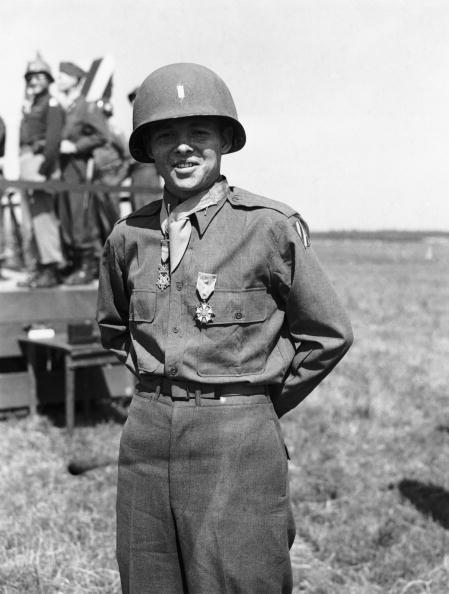
His most famous act of valor occurred in January 1945 in eastern France, when he single-handedly held off an advancing German force after his unit was decimated. Despite being wounded, Murphy climbed onto a burning tank destroyer and used its mounted machine gun to repel the enemy for nearly an hour while directing artillery fire. For this action, he received the Medal of Honor at the age of 21.
By the war's end, Murphy had become the most decorated American soldier of World War II, earning 33 medals and decorations from the U.S. and allied nations. When he returned home, he was greeted with parades, magazine covers, and widespread public admiration, becoming the face of American wartime heroism.
Getty Images
Hollywood Career
Murphy's fame attracted the attention of actor James Cagney, who helped him transition into Hollywood. Murphy made his film debut in 1948 with "Beyond Glory," and over the next two decades appeared in roughly 40 films. Many were Westerns and war movies, in which he often portrayed earnest, morally driven characters that mirrored aspects of his real-life persona.
His most notable film was "To Hell and Back," released in 1955, based on his autobiography of the same name. The film, in which Murphy played himself, became a major box-office success and remains one of the highest-grossing war films of its era. Murphy later described the experience as emotionally jarring, as it forced him to reenact traumatic moments from the war.
Other notable films from his career include "The Red Badge of Courage," "Destry," "No Name on the Bullet," "The Quiet American," and "The Unforgiven." Murphy also starred in the television series "Whispering Smith." Despite steady work, he often joked about his lack of acting ability and openly acknowledged that financial necessity, not artistic ambition, motivated much of his film career.
Personal Struggles and Later Years
Behind his public image, Murphy struggled deeply with the psychological aftermath of war. He suffered from severe nightmares, insomnia, and emotional volatility, symptoms now widely recognized as post-traumatic stress disorder. For years, he slept with a loaded handgun under his pillow and avoided crowds whenever possible.
Murphy experienced financial difficulties later in life and declared bankruptcy in 1968 after years of unsuccessful business ventures and inconsistent film income. He was married twice, first briefly to actress Wanda Hendrix in 1949, and later to Pamela Archer, a former airline stewardess, with whom he had two sons.
Despite his challenges, Murphy remained outspoken about the toll of war on soldiers and quietly advocated for better treatment of veterans long before such conversations became mainstream. He often rejected the glorification of combat, once remarking that people never truly survive a war, they simply learn to live with it.
Death and Legacy
Audie Murphy died on May 28, 1971, at the age of 46, in a plane crash near Roanoke, Virginia. The twin-engine aircraft went down in poor weather conditions on Brush Mountain, killing Murphy, the pilot, and four other passengers. The National Transportation Safety Board investigated the crash, though no single definitive cause was immediately established.
Murphy was buried with full military honors at Arlington National Cemetery, where his grave remains one of the most visited in the cemetery's history. In keeping with his modesty, his headstone was deliberately kept simple, without the gold leaf typically used for Medal of Honor recipients.
Today, Audie Murphy is remembered as a towering figure in American history. His name endures through hospitals, highways, veterans' organizations, and the Audie Murphy Club, which recognizes excellence among noncommissioned officers in the U.S. Army. His life stands as a powerful reminder that extraordinary heroism often comes at an extraordinary personal cost.
Plane Crash Settlement
In 1975, a court awarded Audie's widow and their two children $2.5 million in damages due to the accident. That's the same as $15 million today.
Read more: Audie Murphy Net Worth


0 Comments