

It's probably safe to assume that Jensen Huang is having one of the worst weeks of his life.
On Sunday, November 8, 2026, the NVIDIA founder and CEO admitted to having an extramarital affair. That would be embarrassing enough for a married man who also happens to be one of the richest people on the planet. Unfortunately for Jensen, the woman reportedly involved in the affair, Alice Huang, is a Chinese business executive whom U.S. intelligence officials suspect of working for Beijing.
NVIDIA's board has launched an independent investigation into whether Jensen was targeted by a foreign intelligence operation. The company says it has no reason to believe corporate secrets or national security were compromised. Meanwhile, NVIDIA shares fell more than 4% on Monday, wiping roughly $190 billion off the company's market capitalization.
Not great!
Now, I'm certainly not suggesting that Jensen should be celebrating any of this. The allegations raise serious questions that go far beyond his personal life, and nobody knows how the investigation will end.
But if Jensen is looking for a little encouragement, I have two stories that might cheer him up. Both involve extremely wealthy businessmen whose lives were turned upside down by humiliating sex scandals. Both were pushed into major financial decisions they probably never would have made otherwise. And in both cases, those decisions turned out to be among the luckiest financial breaks imaginable.
One man escaped the collapse of Enron with $353 million in stock-sale proceeds. The other emerged from his scandal with more than $7 billion in cash just before a global economic catastrophe.
Let's start with a man who might be the only corporate executive in history whose affair with a stripper accidentally saved him hundreds of millions of dollars.

(Photo by Woohae Cho/Getty Images)
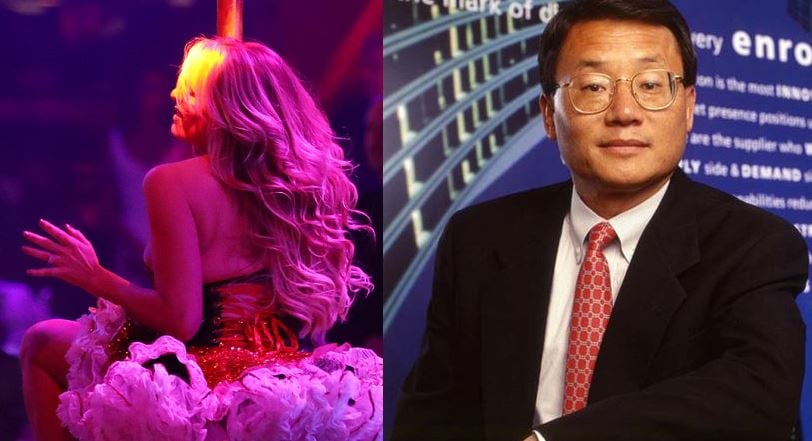
Lou Pai: The Enron Executive Who Accidentally Saved $353 Million
In the late 1990s, Lou Pai was one of the most powerful executives at Enron, the Houston-based energy company that would eventually become synonymous with corporate fraud.
Born in China and raised in Maryland, Pai was a brilliant mathematician who joined Enron in 1987. He eventually became one of Jeff Skilling's most trusted executives. In 1997, he was appointed CEO of Enron Energy Services, an ambitious division that hoped to revolutionize how American households and businesses purchased electricity and natural gas.
Unfortunately, the division was a financial disaster. It consumed hundreds of millions of dollars without generating the revenues its executives had promised. But Enron's stock was soaring, its executives were earning enormous compensation packages, and nobody seemed particularly interested in slowing down the party.
Especially Lou Pai.
According to Bethany McLean and Peter Elkind's excellent book, "The Smartest Guys in the Room," only two things appeared to motivate Pai: money and a peculiar fascination with strippers.
Lou reportedly visited a Houston strip club almost every night after work. He allegedly conducted business meetings there, entertained employees there, and charged some of the festivities to his Enron corporate expense account. As the story goes, he even brought dancers back to Enron's offices for late-night parties.
My favorite detail is the alleged method he used to conceal his activities from his wife. Before going home, Lou would reportedly stop at a gas station and splash gasoline on himself to disguise the smell of the strip club.
I'm not a marriage counselor, but I suspect consistently coming home smelling like gasoline might eventually raise a few questions.
And it did not work.
At some point, Lou began having an affair with a dancer named Melanie Fewell. There were two complications. First, Lou was married to his wife, Lanna, with whom he had two children. Second, Melanie was also married with two children of her own.
Then came complication number three: Melanie became pregnant.
Lou and Melanie welcomed a daughter in April 1997. Lanna learned about the affair and the child in 1998, and the marriage unraveled. What followed was an extremely expensive divorce involving a complicated division of Lou's assets, including the enormous fortune he had accumulated in Enron stock.
And this is where the story takes an absolutely extraordinary turn.
The Most Fortunate Divorce Settlement In Corporate History?
At the time, Enron was one of Wall Street's hottest companies. Its stock had risen dramatically throughout the 1990s, and its executives were convinced the company was only beginning to realize its potential.
Lou Pai had accumulated millions of shares and stock options. Under the terms of his divorce settlement, finalized in 2000, he needed to liquidate substantial holdings and divide the proceeds with his former wife.
Ordinarily, being forced to sell your employer's rapidly appreciating stock would seem like terrible luck. Imagine having to sell millions of dollars in Apple shares in 2005, or NVIDIA shares in 2015, just to pay for a divorce.
But Enron was not NVIDIA.
Pai sold a substantial amount of Enron stock in 2000 and continued selling shares as he prepared to leave the company, including additional transactions between May 18 and June 7, 2001.
In total, Pai sold approximately $353 million worth of Enron stock before the company collapsed. Much of it was sold when shares were trading at elevated prices, although his May and June 2001 transactions averaged approximately $54 per share.
Three hundred and fifty-three million dollars!
Obviously, a significant portion of those proceeds went to his ex-wife, Lanna, who also received valuable real estate. But Lou still emerged from the divorce with an enormous personal fortune.
At the time, he probably thought the divorce was one of the most expensive mistakes of his life.
He was about to discover it had been one of the luckiest.
And Then Enron Collapsed
Throughout 2000 and 2001, Enron executives were increasingly using questionable accounting methods to make the company's finances appear much healthier than they actually were. They booked anticipated profits from long-term contracts before earning them and used complicated partnerships to conceal enormous debts.
Meanwhile, executives, including Ken Lay and Jeff Skilling, were publicly assuring investors that the company remained financially sound.
Enron's stock had reached an all-time high of approximately $90 in August 2000. By August 2001, it had fallen to around $40. By October, it was below $20. By the end of November, it was trading for approximately $1.
On December 2, 2001, Enron filed for bankruptcy. It was the largest corporate bankruptcy in American history up to that point.
Thousands of employees lost their jobs. Investors lost billions. Workers who had invested their retirement savings heavily in Enron stock watched those savings evaporate. Former executives eventually faced criminal trials, prison sentences, and financial ruin.
And Lou Pai?
Lou Pai had already sold $353 million worth of Enron stock.
His affair, unexpected child, and resulting divorce had helped push him to sell stock in a company that was about to become virtually worthless.
His exit wasn't entirely without legal consequences. In 2008, the Securities and Exchange Commission accused Pai of insider trading in connection with his May and June 2001 transactions. The SEC alleged he possessed material, nonpublic information about problems at Enron Energy Services. Pai settled the civil charges for $31.5 million without admitting or denying the allegations and accepted a five-year ban from serving as an officer or director of a public company.
An expensive settlement, certainly. But a fraction of his total stock-sale proceeds.
And there's another twist. Lou's relationship with Melanie wasn't just a fling. They married and remained together for decades, operating horse farms and building a life after Enron. In 2022, they purchased an $8.2 million equestrian estate in Wellington, Florida.
For a detailed account of the affair, divorce, and extraordinary timing, check out our original article: "How One Very Lucky Enron Exec Made $350 Million By Impregnating A Stripper, Destroying His Marriage And Losing His Job."
But Lou Pai isn't the only businessman whose embarrassing encounter with exotic entertainment produced an incredible financial windfall.
For our second story, we need to travel from Houston strip clubs to one of the most expensive ski resorts in the French Alps.

Getty
Mikhail Prokhorov: A Billionaire, A Ski Resort, And A Very Bad Vacation
In January 2007, Russian billionaire Mikhail Prokhorov was living a life that would make most ordinary millionaires jealous.
Prokhorov was a tall, wealthy, unmarried mining tycoon. He owned a substantial stake in Norilsk Nickel, one of the world's largest nickel and palladium producers, and controlled a sprawling business empire alongside his longtime partner, Vladimir Potanin.
The two men had built their fortunes during Russia's chaotic transition from communism to capitalism, acquiring enormously valuable industrial assets through the country's controversial privatization program. As commodity prices exploded during the 2000s, their holdings became worth billions.
Prokhorov was also famous for his extravagant lifestyle. Private jets, yachts, beautiful women, and lavish parties were all part of the package.
In January 2007, Mikhail traveled to Courchevel, the ultra-exclusive French ski resort favored by Russian oligarchs, European royalty, and wealthy celebrities.
He brought an entourage that included friends, staff members, and several young Russian women. According to French authorities, some of the women were suspected of being paid escorts brought to entertain wealthy guests. Prokhorov denied the allegations, maintaining that the women were simply members of his social circle.
On January 9, French police launched a major raid involving dozens of officers. They detained 26 people, including Prokhorov, as part of an investigation into a suspected prostitution network.
Imagine being one of the richest men in Russia, flying your private jet to a luxurious Alpine resort, checking into a spectacular hotel, and then spending several days in a French jail while police investigate whether you've been organizing parties involving prostitutes.
Not exactly the relaxing ski vacation you had in mind.
Prokhorov was ultimately released without criminal charges. He denied wrongdoing, and the allegations were never proven against him. But the arrest became an international embarrassment, generating headlines around the world and causing serious problems back in Russia.
Especially with his business partner.
The $7 Billion Breakup
For years, Prokhorov and Vladimir Potanin had operated one of Russia's most powerful business partnerships. Their combined holdings included stakes in mining, banking, and numerous other industries. Norilsk Nickel was their crown jewel.
But their relationship had already begun deteriorating over disagreements about strategy and control. Prokhorov's arrest made matters considerably worse. Potanin was reportedly furious about the publicity, and the incident helped accelerate a separation that had been brewing for some time.
Over the following year, the two men fought bitterly over how to divide their empire. Eventually, Prokhorov decided to sell his approximately 25% stake in Norilsk Nickel.
In April 2008, he completed a deal to transfer that stake to UC Rusal, the aluminum giant controlled by fellow Russian billionaire Oleg Deripaska.
The transaction delivered more than $7 billion in cash to Prokhorov, along with approximately 14% ownership of Rusal.
Under ordinary circumstances, selling such an important piece of one of Russia's most valuable companies might have been a terrible mistake. Norilsk was enormously profitable, commodities prices were booming, and wealthy investors were scrambling to acquire precisely the kinds of assets Prokhorov had just sold.
But the timing of his exit was almost impossibly good.
And Then The Global Economy Collapsed
On September 15, 2008, less than five months after Prokhorov completed his Norilsk sale, Lehman Brothers filed for bankruptcy. The global financial crisis that followed devastated stock markets, banks, and commodity producers around the world.
Russia was hit especially hard. Falling metals prices, collapsing valuations, and enormous corporate debts wiped billions from the fortunes of the country's wealthiest businessmen.
Oleg Deripaska, who had acquired Prokhorov's Norilsk stake, watched his estimated net worth plunge from $28 billion to a small fraction of that amount. Vladimir Potanin also experienced a devastating decline in his fortune.
Prokhorov, meanwhile, had converted one of his largest holdings into billions of dollars in cash just before the disaster.
He wasn't completely insulated from the crash. His Rusal shares and other investments also declined. But the enormous cash portion of his sale gave him something many other Russian billionaires desperately needed and couldn't obtain:
Liquidity.
Instead of scrambling to satisfy creditors and prevent his businesses from collapsing, Prokhorov could look for investment opportunities. He emerged as Russia's richest man in 2009, with an estimated fortune of $9.5 billion.
He also became an NBA owner, acquiring control of the New Jersey Nets in 2010. The team eventually relocated to Brooklyn, and Prokhorov completed the sale of his basketball and arena interests in 2019 in transactions valuing the combined assets at approximately $3.5 billion.
Think about the sequence. A billionaire gets arrested during a scandalous vacation in the French Alps. His longtime business partnership implodes. He sells billions of dollars worth of mining assets.
And then, five months later, the global economy collapses.
He could not have timed the sale much better if he'd been handed a calendar showing the exact date of the financial crisis.
For the full story, read our earlier article: "How A Private Jet Full Of Prostitutes Earned Mikhail Prokhorov $10 Billion."
So, Cheer Up Jensen Huang?
Right now, Jensen is dealing with an embarrassing admission, trouble on the marital front, a board investigation, and serious questions about his leadership of one of the world's most important companies. There's no guarantee any of this ends well for him.
But if Lou Pai and Mikhail Prokhorov teach us anything, it's that the financial consequences of a spectacular personal scandal aren't always what anyone expects.
Consider one entirely hypothetical scenario. Let's say Jensen's wife files for divorce, and the resulting settlement forces him to liquidate tens of billions of dollars worth of NVIDIA shares. He hands over a substantial chunk to his wife, but he also walks away with billions in cash.
Now, let's say, again, purely hypothetically, that we're actually in a massive AI bubble. And six months after Jensen's divorce settlement, that bubble bursts in spectacular fashion, sending NVIDIA's stock down 90%.
Suddenly, what seemed like the most financially devastating event of Jensen's life has accidentally saved him tens of billions of dollars. He would have achieved the greatest stock market timing of his career without even trying. All thanks to an affair that, at the time, seemed like an unmitigated disaster.
Sound ridiculous? Maybe. But so would the stories of Lou Pai and Mikhail Prokhorov if they hadn't actually happened.
So, cheer up, Jensen. I'm not saying your current predicament will turn out to be the greatest financial break of your life. I'm just saying stranger things have happened.


0 Comments